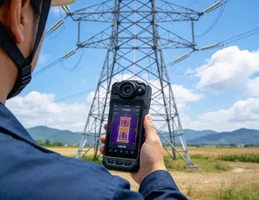
Grid Inspection Smart PDA: From Tool to Ecosystem – Free Software Customization Opens a New Chapter in O&M
Smart PDAs are becoming indispensable tools for grid inspection, leveraging high-definition cameras, infrared thermal imaging, and AI recognition technology to significantly improve defect detection rates. With complimentary software customization services, inspection workflows and data management are seamlessly integrated, enabling low-cost, high-efficiency O&M upgrades.
In the daily operation and maintenance of transmission lines, traditional manual inspection methods are facing efficiency bottlenecks: paper records are prone to errors, data retrieval is difficult, and on-site defect identification relies on experience. The emergence of intelligent PDAs (Personal Digital Assistants) is quietly changing this situation. As an expert in power distribution and transmission, I have personally experienced multiple technological iterations. Today, let's discuss how this device has evolved from a simple tool to an ecosystem core, especially how our free customization supporting software can make inspection work more efficient with less effort.
Core Advantages of Intelligent PDA
Intelligent PDAs on the market are not simply upgraded smartphones. They are designed for harsh environments, featuring IP68 waterproof and dustproof ratings, resistance to drops from 1.5 meters, and stable operation from -20°C to 60°C. More importantly, they integrate high-resolution cameras, infrared thermal imaging modules, and laser rangefinders. Combined with built-in AI chips, they can identify common defects such as damaged Insulators, broken strands of conductors, and insufficient clearance from trees in real time.
| Function Module | Traditional Manual | Intelligent PDA |
|---|---|---|
| Defect Identification | Visual observation, relies on experience | AI auto-labeling, accuracy >95% |
| Data Recording | Handwritten paper forms, easily lost | Cloud real-time upload, auto-generate reports |
| Positioning Accuracy | GPS error 10 meters | RTK centimeter-level positioning |
| Battery Life | No auxiliary | Removable battery, continuous operation for 12 hours |
For example, during a 220kV line inspection, maintenance personnel used an intelligent PDA to scan a tower. The system immediately displayed historical data: the tower had caused a trip due to a bird's nest last year. Combined with infrared images, an abnormal temperature of an Insulator was detected, which was ultimately confirmed as a zero-value Insulator, preventing a power outage. This shift from reactive to proactive is the value of the intelligent PDA.
Free Customization Software: Breaking Data Silos
Without suitable software support, even the best hardware is useless. Many enterprises purchase equipment only to find that the accompanying software is either redundant in functions or incompatible with existing systems, forcing manual data export. To address this, we have launched a free Customization supporting software service, with the core logic being 'configure on demand, start with zero cost.'
Specifically, customers only need to provide their inspection workflow (such as tower numbering rules, defect classification standards, and report formats), and our development team will complete the Customization within 20 working days. The software supports offline mode, allowing data recording even in network blind spots, and automatically syncs when connected. For example, a power company required inspectors to take 10 photos of towers daily and automatically generate A4-format inspection cards. Through Customization, the PDA automatically adds watermarks (time, coordinates, tower number) after taking photos, generates PDF files, and sends them directly to the backend system.
Additionally, the software provides open API interfaces for integration with existing ERP or GIS platforms. In the past, a medium-sized power supply bureau spent approximately 200,000 RMB annually on data entry and verification labor costs. Now, with the free Customization software, this cost is nearly eliminated. We even offer lifetime free upgrades to ensure the software evolves alongside the hardware.
Practical Case Study: From Pilot to Full Deployment
Last year, we assisted a provincial transmission company in deploying 500 intelligent PDAs. The initial pilot was conducted on mountain lines with poor signal and complex terrain. Maintenance personnel reported that the PDA's offline map feature solved navigation issues, and AI identification reduced re-inspection workload by 40%. After three months, the defect detection rate increased from 78% to 96%, and average inspection time was reduced by 35%. Based on this, the company decided to cover all teams by the end of the year.
Notably, the Customization software includes a 'defect closed-loop management' module: after an inspector identifies a defect, the PDA automatically generates a work order and pushes it to the repair team; after repair, photos are uploaded, and the system automatically compares before and after states, confirming qualification before archiving. The entire process requires no manual intervention, truly achieving the integration of data flow and business flow.
Future Outlook: From Tool to Platform
The next step for the intelligent PDA is to become the 'mobile brain' of power grid operation and maintenance. By accumulating inspection data, we can train more accurate defect prediction models. For example, based on historical infrared images, we can predict which Insulators are likely to flash over during the thunderstorm season. The free Customization software acts like a building block, allowing power enterprises of different sizes to access this ecosystem at low cost.
If you are struggling with the digitalization of power grid inspections, consider trying this solution. Remember, 'free' is not a gimmick; it is our commitment to driving industry progress. After all, when every inspector has a capable PDA, the safe operation of the power grid has the most solid guarantee.